Bright-room UST owners
Fresnel optics are especially relevant when daytime or overhead ambient light is part of normal viewing. The merchant markets this model around 95% ambient-light rejection and higher gain than many lenticular UST surfaces.
The NothingProjector Fscreen Fresnel model is a fixed-frame, wall-mounted UST screen built around a directional Fresnel PET optical surface. The key buying question is not whether the headline specifications look impressive—it is whether the screen's brightness, light rejection and viewing geometry fit your room.
Affiliate disclosure: we may earn a commission from qualifying purchases made through product links.
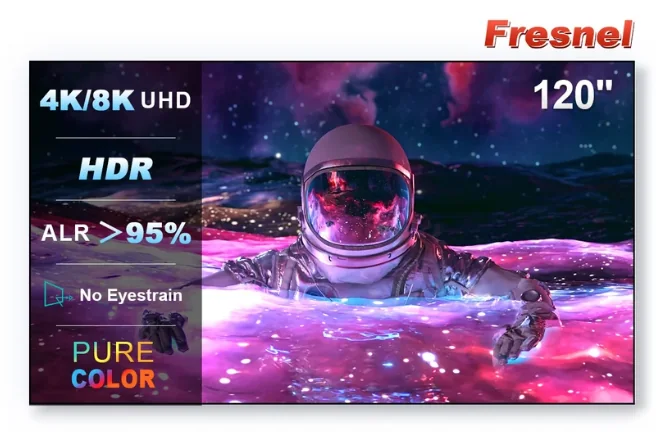
NothingProjector's regional pages have shown different viewing-angle figures for Fresnel variants. Treat viewing angle as a specification to confirm on the live product page for your region before ordering.
Pricing, stock and regional shipping can change. Use the live product page for the current terms that apply to you.
Check price & availability Affiliate link. We may earn a commission if you buy.Fresnel optics are especially relevant when daytime or overhead ambient light is part of normal viewing. The merchant markets this model around 95% ambient-light rejection and higher gain than many lenticular UST surfaces.
Directional screens reward a well-planned seating position. If your primary seats are centered, higher on-axis brightness can be more useful than an extremely wide viewing cone.
This is a fixed-frame wall installation, so it fits rooms where the screen can remain visible rather than retracting when not in use.
A Fresnel surface is not just a gray screen. Its optical structure controls where light goes. That can preserve contrast and perceived brightness in a lit room, but the same directionality can make seat placement more important than on a wide-angle lenticular surface.
If you regularly host a large group spread across a wide sofa, compare Fresnel and lenticular behavior before choosing. If most viewing happens from a central seating zone, Fresnel's directional behavior may be a better fit.
NothingProjector prices and stock vary by region, warehouse and promotion. We intentionally do not hard-code a price here. The useful value comparison is screen performance relative to your room: if a screen lets you keep lights on, use a larger image or preserve contrast during daytime viewing, that can be more important than the cheapest frame-and-fabric option.
See today's product page| Check | Why it matters |
|---|---|
| Your projector is UST | This screen is designed around the steep projection angle of ultra-short-throw projectors. |
| Wall space | The listed 120-inch image area is about 2657 × 1494 mm before you account for the frame and installation clearance. |
| Projector placement | UST geometry is sensitive to height, offset and level. Confirm your projector's 120-inch placement requirements. |
| Seating width | A more directional optical surface can reward central seats and be less uniform at extreme off-axis positions. |
| Current regional specification | Merchant listings have varied on viewing-angle figures across regions and variants. |
| Shipping path | A 120-inch fixed-frame screen is a large shipment. Check current warehouse, delivery and return terms for your location. |
The strongest case for this screen is a 120-inch UST setup in a multipurpose room where ambient light is a recurring problem and the main viewers sit within a reasonably central seating zone. The reason to choose it is not the word “Fresnel” by itself; it is the combination of directional optics, a manufacturer-listed 1.2 gain and a 95% ALR claim in a fixed-frame format.
If your room is already fully dark or your seating stretches very wide, the trade-offs become different. Use the guides below before deciding.
Check the live NothingProjector product page for today's price, stock and shipping terms.
Check current offer Affiliate link. We may earn a commission.