Fresnel projector screens: the practical guide
A Fresnel projector screen is an optical surface, not simply a colored fabric. Its fine concentric structures redirect light in a controlled way, which is why it can look dramatically different from a white wall in ambient light.
Affiliate disclosure: we may earn a commission from qualifying purchases made through product links.
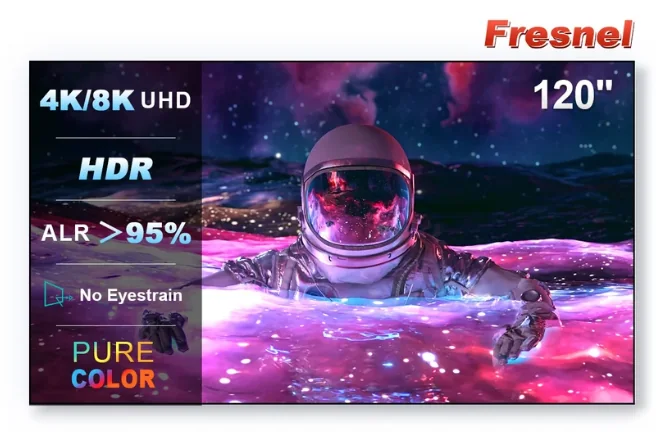
How the optical structure works
Instead of reflecting incoming light equally in every direction, a Fresnel surface uses many tiny concentric optical features to concentrate useful projector light toward the audience. Stray room light arriving from other directions is more likely to be absorbed or redirected away from the viewer.
What that changes
You can gain perceived brightness and contrast from the primary seating area, especially in rooms with overhead or side light. The same directionality also means the image can change as you move far off-axis.
What the marketing numbers mean
| Spec | Useful interpretation |
|---|---|
| Gain | Relative reflected brightness in a defined direction. Higher is not automatically better. |
| ALR percentage | A manufacturer measure of how much non-image light the screen rejects under stated conditions. Compare cautiously across brands. |
| Viewing angle | The usable off-axis viewing region. Test or confirm the method behind the stated number when possible. |
| Resolution support | The screen surface should be fine enough not to visibly interfere with projected detail; it does not create extra resolution by itself. |
Fresnel is strongest when these conditions overlap
- You use an ultra-short-throw projector.
- You want to watch with some ambient light present.
- Your primary seats sit within a reasonably centered viewing zone.
- You can install a flat, permanent fixed-frame screen.
See how those criteria map to the NothingProjector 120-inch Fresnel →